
Most people don’t get supply chain.
Even after COVID, supply chain remains a mystery.
That’s why so many miss the fascinating possibilities it offers.
I didn’t grow up wanting to be in supply chain.
I earned a bachelor’s degree in accounting, following in my dad’s footsteps.
My first real encounter with supply chain came during my MBA at Michigan State in 2003. Since then, I’ve had the chance to explore many exciting areas across the field.
My heart is with planning, but all areas are fascinating.
In this post, you will have:
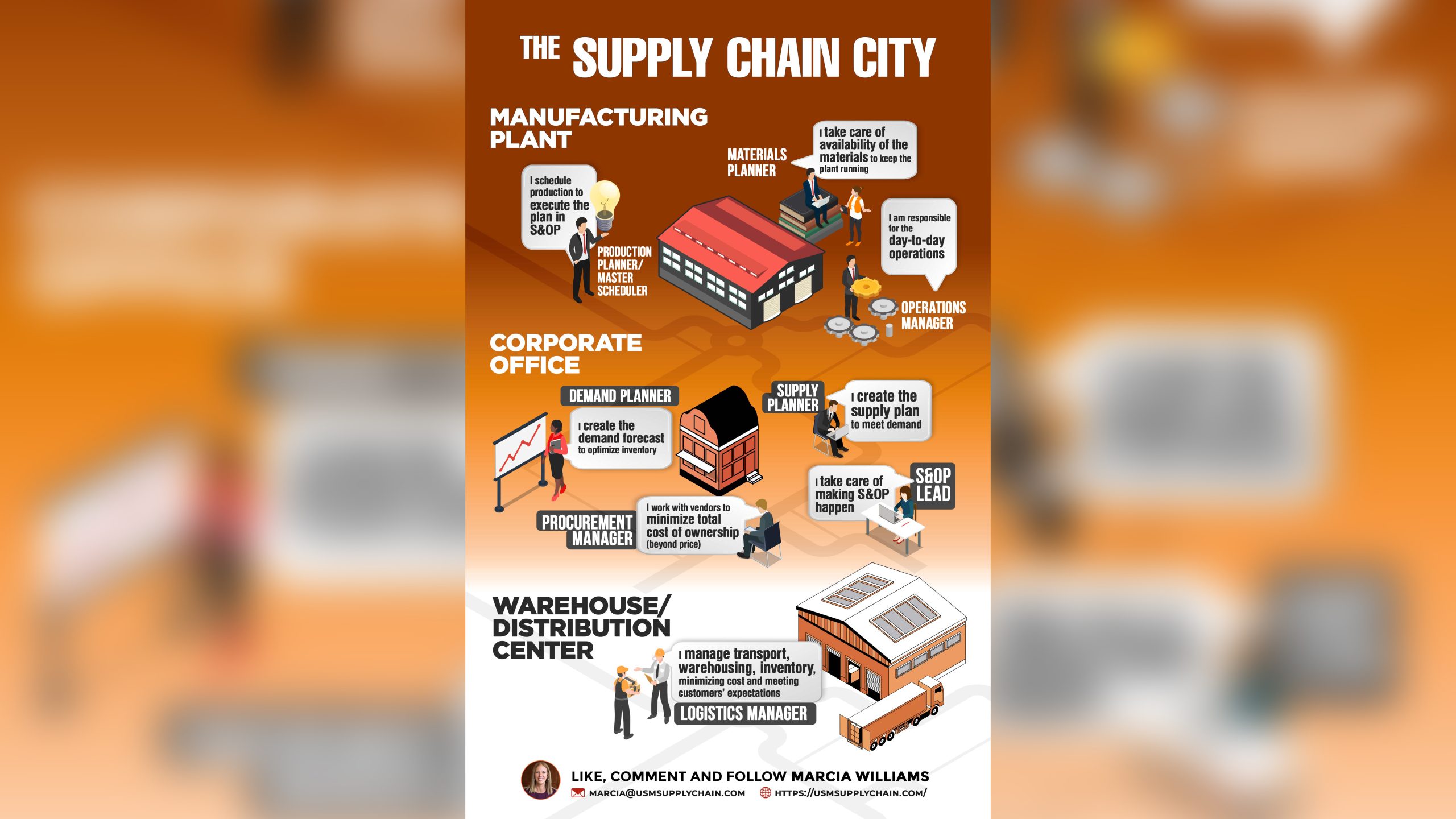
- Expanded explanations on an infographic I posted on LinkedIn about the Supply Chain City
- Action to take by role to get immediate results
- Key metrics by role
Let’s dive in!
1. Demand Planner
Role: Create the demand forecast to optimize inventory and drive alignment.
Action to Take for Quick Win:
Audit top 20 SKUs. Identify high-variance items. Improve inputs (promo uplifts, seasonality, assumptions).
Top 3 Metrics:
- WMAPE (Weighted Mean Absolute Percentage Error) = Σ |Forecast – Actual| × Volume ÷ Σ Volume × 100
- Forecast Bias (%) = Σ(Forecast – Actual) ÷ Σ Actual × 100
- Forecast Value Add (FVA) = Forecast Accuracy (Statistical) – Forecast Accuracy (Baseline/Naive)
2. Supply Planner
Role: Translate the demand forecast into a feasible supply plan that balances service, cost, and capacity.
Action to Take for Quick Win:
Review coverage days for high-impact SKUs. Are you holding too much or risking a stockout? Adjust safety stocks or order frequency to align with demand volatility.
Top 3 Metrics:
- OTIF (On-Time, In-Full)
= (Orders Delivered On Time and In Full ÷ Total Orders) × 100 - Plan Adherence (%)
= (Units Supplied as Planned ÷ Planned Units) × 100 - Inventory Turns
= Cost of Goods Sold ÷ Average Inventory
3. Procurement Manager
Role: Secure supply at the lowest total cost of ownership, minimizing risk and building strategic supplier partnerships.
Action to Take for Quick Win: Conduct a spend analysis. Identify top categories or suppliers where costs have increased. If it’s been a while since you’ve gone to market or renegotiated contracts, now’s the time to act.
Top 3 Metrics:
- Cost Savings ($ or %)
= Baseline Spend – Actual Spend (after procurement actions) - Purchase Price Variance (PPV)
= (Standard Price – Actual Price) × Quantity Purchased - Spend Under Contract (%)
= Spend Covered by Contracts ÷ Total Spend × 100
4. Production Planner / Master Scheduler
Role: Create executable schedules that align with capacity and demand.
Action to Take for Quick Win:
Compare last week’s planned vs. actual production. Investigate delays and re-sequence if needed.
Top 3 Metrics:
- Schedule Adherence (%) = Actual Production as per Schedule ÷ Total Scheduled × 100
- Throughput Rate = Total Units Produced ÷ Time Period
- Changeover Time = Average Time Between Product Switchovers
5. Materials Planner
Role: Ensure material availability to keep production running.
Action to Take for Quick Win:
Identify materials with late deliveries. Adjust reorder points or expedite purchase orders (PO) follow-up.
Top 3 Metrics:
- Material Availability Rate (%) = Orders with All Materials Available ÷ Total Orders × 100
- Supplier Delivery Performance = On-Time Receipts ÷ Total PO Lines × 100
- Backorder Rate = Backordered Quantity ÷ Total Ordered Quantity × 100
6. Operations Manager
Role: Run the plant efficiently; managing people, machines, and daily execution.
Action to Take for Quick Win:
Do a daily floor walk. Identify delays due to materials, staffing, or maintenance.
Top 3 Metrics:
- OEE (Overall Equipment Effectiveness) = Availability × Performance × Quality
- Downtime (%) = Downtime Hours ÷ Total Available Hours × 100
- Labor Productivity = Units Produced ÷ Direct Labor Hours
7. Logistics Manager
Role: Ensure timely, efficient movement and storage of goods across the supply chain; from warehouse to customer.
Action to Take for Quick Win:
Review on-time delivery performance. Are delays coming from carriers, poor handoffs, or warehouse loading inefficiencies? Work with 3PLs or internal teams to address root causes.
Top 3 Metrics:
- On-Time Delivery (%)
= (Deliveries Arrived On or Before Requested Date ÷ Total Deliveries) × 100 - Pick Accuracy (%)
= (Correct Picks ÷ Total Picks) × 100 - Dock-to-Stock Time
= Time from Receiving to Stock Availability
Supply chain is full of fascinating roles and they keep evolving.
Which one do you love the most, and why?


